
The Rules of Padel: 2026 FIP Edition
Padel rules sit under the International Padel Federation (FIP), whose 2026 edition was adopted at the General Meeting in Acapulco on 28 November 2025. Two changes matter most: the Star Point is now a FIP-recognised deuce option used by Premier Padel and the CUPRA FIP Tour, and the serve rule now requires one foot behind the service line with the ball not crossing the line until struck.
This is the Padeli editorial summary of the FIP 2026 Rules of Padel, written for UK and English-speaking club players who want the changes plain. We link the official FIP 2026 rulebook PDF and the LTA padel section as the primary sources.
For UK context we link our own LTA Padel glossary entry. Anything contested goes back to the FIP text.
Court and net basics
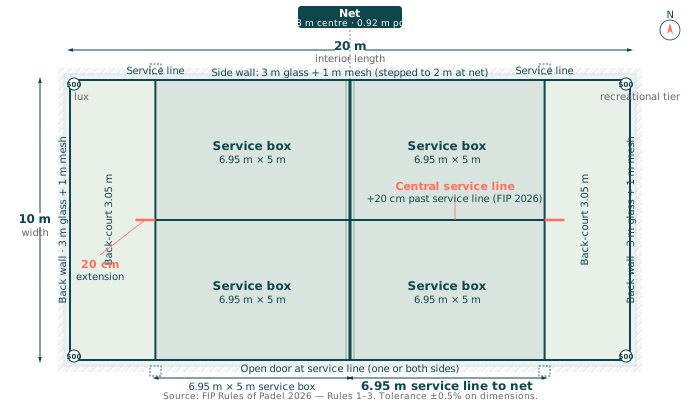
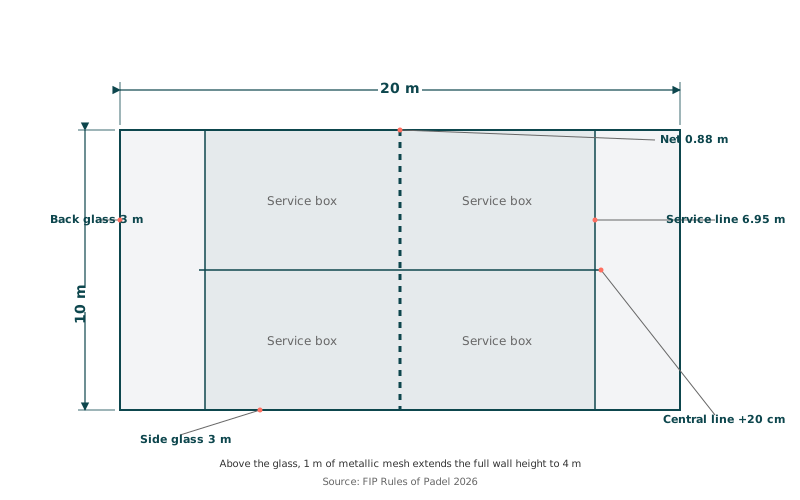
A padel court is 20 metres long and 10 metres wide, with a 0.5% tolerance permitted under the FIP 2026 dimensions section. Every line on the court is 5 cm wide and a contrasting colour to the playing surface.
The service line sits 6.95 metres from the net on each side, and the central service line divides the two service boxes. For the full walkthrough of court geometry, see our padel court guide.
One small wording change for 2026 is worth flagging here. The central service line is now described as having a “minimum 20 cm extension” past the service line on the back-wall side, rather than the previous wording that said it extends 20 cm. The geometry is unchanged in practice, but the wording is part of the 2026 update.
The net is 10 metres long and sits at 0.88 m in the centre, rising to 0.92 m at the posts, with a tolerance of plus or minus 0.005 m. The end walls are 3 m of solid surface topped by 1 m of metallic mesh.
Side walls come in two recognised variants: the classic stepped 3-2-3 m staircase and the all-crystal panoramic style now common in new builds. For more detail on the wall variants and how they affect play, see our court guide.
Permitted playing surfaces under FIP 2026 are cement, synthetic and artificial grass. Older rulebooks listed wood and porous conglomerate; the 2026 edition does not. If you play on a wooden indoor surface, that court is not FIP-compliant for sanctioned competition, even if it is fine for casual play.
One common misconception we want to correct here. A padel court is not a third the size of a tennis court. Padel is roughly 77% of a tennis doubles court, around 200 m² of playing area versus the tennis figure near 260 m². The walls make it feel smaller, the geometry does not.
The serve - underarm only
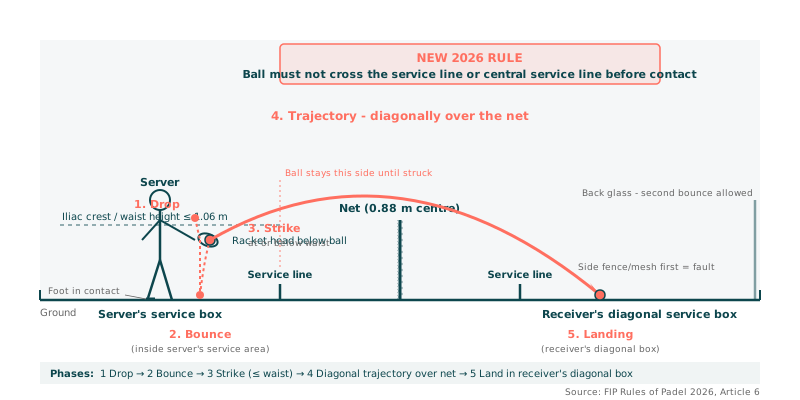
The padel serve is underarm only, struck at or below hip height, with the ball bounced once on the floor first. The 2026 edition introduces two changes that every regular player needs to know: the foot rule is now one foot rather than both, and the ball may not cross the service line before contact.
How a legal padel serve works
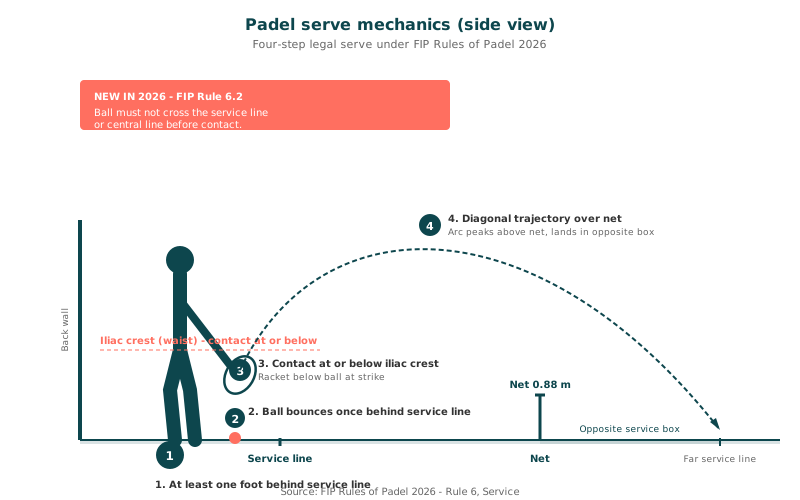
- Stand with at least one foot behind the service line and on the correct side of the central line (FIP 2026 Rule 6, new wording for 2026; the previous edition required both feet).
- Bounce the ball once on the floor behind the service line.
- Strike the ball at or below the level of the iliac crest, the top of your hip bone.
- The ball may not cross the service line or the imaginary line until it is struck (FIP 2026 Rule 6 point 2, new clause for 2026).
- The ball must land diagonally in the opposite service box. After the bounce it may touch the side wall and stay in play; it may not touch the metallic mesh.
Each game starts with a 3-minute warm-up rally before the first point, set out in FIP 2026 Rule 2.2. The server gets two service attempts. A second fault loses the point.
Service alternates between the two pairs at the end of each game, and within a pair the players agree the serving order at the start of each set.
What the 2026 serve rule changes
Two clauses changed at the FIP General Meeting in Acapulco on 28 November 2025. The ball-crossing-line clause is new, and the foot-position requirement was relaxed from both feet to one foot. The mini-table below shows the before-and-after for clarity.
| Element | Pre-2026 | FIP 2026 |
|---|---|---|
| Feet position | Both feet behind line | One foot behind line |
| Ball over line before contact | Not addressed | Not permitted |
Faults, lets and second serves
A foot fault is called when any foot crosses or touches the line at the moment of contact. A net fault is the ball going into the net, landing on the mesh in the receiver’s box, or landing outside the correct service box. A bounce fault covers striking before the bounce or above hip height.
Lets exist in padel, despite a common myth that they do not. FIP 2026 Rule 9 covers the let on serve: a serve that clips the net and lands in the correct service box is a let and is replayed.
Rule 9 point 2 covers rally lets, used when a ball or object enters the court that should not be there.
The “padel has no lets” line gets repeated on social, and it is wrong. It often comes from confusion with the Golden Point or Star Point, where there is no second chance on the decisive point itself.
The let on a clean net-clip serve is still in the rulebook. For more on serve mechanics, faults and the 2026 rule, see our padel serve guide.
Scoring - three deuce options for 2026

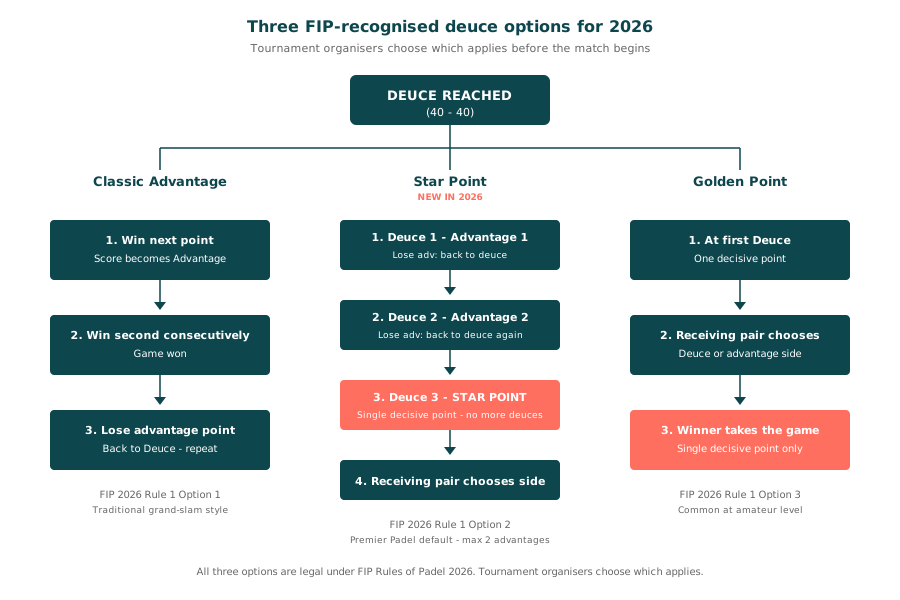
Padel scoring borrows the tennis count, then forks at deuce. From 2026 the FIP rulebook recognises three deuce options: Classic Advantage, Star Point and Golden Point.
Premier Padel and the CUPRA FIP Tour have moved to the Star Point as their default from January 2026. For the full walkthrough of how padel is scored, see our padel scoring guide.
The point, game and set structure
Points run 15, 30, 40 then game. The first pair to six games with a two-game lead wins the set. At six-all the set goes to a tiebreak, first pair to seven points with a two-point lead. Matches are best of three sets in standard FIP competition.
The pre-match 3-minute warm-up rally is set out in FIP 2026 Rule 2.2 and applies in sanctioned play. The other timings worth knowing are 20 seconds between points, 90 seconds at changeovers and 120 seconds between sets.
These are the same numbers many of our readers already know from tennis, with padel-specific tolerances in the rulebook.
The three FIP-recognised deuce options (FIP 2026 Rule 1)
Option 1 - Classic Advantage. At 40-40 you play for advantage. Win the next point for advantage; win two points in a row to take the game. There is no cap on the number of times the game can return to deuce. This is the format most casual club players grew up with from tennis.
Option 2 - Star Point (new in FIP 2026). This is the wedge change for 2026. The Star Point caps the deuce sequence.
From the first deuce the game runs deuce 1 to advantage 1, back to deuce 2, advantage 2, then deuce 3, where a single decisive point - the Star Point - settles the game. The maximum is two advantages from the first deuce before the decisive point.
On the Star Point itself, the receiving pair chooses which side will receive. Players cannot change positions within the pair for the Star Point. The serving pair has no choice in this - the receivers decide the side, and both pairs hold their positions. Defined in FIP 2026 Rule 1 Option 2.
Star Point is now the default for Premier Padel, the CUPRA FIP Tour, FIP Promises and FIP Beyond from 2026, confirmed in the FIP Star Point announcement of 18 December 2025.
The format debuts on the CUPRA FIP Tour at FIP Bronze Melbourne from 5 to 11 January 2026, and on Premier Padel at Riyadh P1 from 9 to 14 February 2026.
Option 3 - Golden Point. A single decisive point at the first deuce. The receiving pair chooses the side. Golden Point remains a FIP-recognised option in 2026 and is still common at club, league and amateur tournament level across the UK and Europe. Organisers pick which deuce option applies before the event starts.
Mixed-doubles decisive point rule
On the decisive point of either the Star Point or the Golden Point in mixed-doubles, the receiver must be the same sex as the server. This is set out in FIP 2026 Rule 1 Options 2.2 and 3.3. The receiving pair cannot swap positions to dodge this requirement, so the matchup is set by the server’s sex.
Walls and mesh - the part that makes padel different
The walls are what separate padel from tennis. Every shot needs a floor bounce on the receiving side before any wall contact.
Once the ball has bounced on the floor, the receiving pair can play it off their own back glass, side glass, or both, and the rally continues. If any of the padel terms in this section are new to you, our padel glossary covers every shot, court part and tactic.
A ball hit directly into the opponent’s wall without a floor bounce on their side is out. The same applies to a ball flicked straight into the mesh on the full.
The mesh comes into play in rallies after the floor bounce: if you can play a ball off the mesh on your side after it has bounced, the point lives on.
Out conditions are clear. A ball going through the mesh, over the back glass, or out through an open door is out. Some clubs use an optional open-door rule for casual play; at FIP-sanctioned events the door rule applies as written in the rulebook.
The shot every new player asks about is the “por tres“, literally “through three”. The ball is played around the side post, outside the structure, and lands back inside the playing area.
It is legal, spectacular and a staple of the Premier Padel highlight reel. Por cuatro - “through four” - is when the ball goes through the side mesh and is far rarer.
The wall framing we give our coaching readers is simple. The wall is your friend on defence, where it buys you time to recover and reset. The wall is your enemy on attack, because a ball that sits up off the back glass is a gift to the opposing net pair.
Ball, racket and player equipment
The ball
The FIP 2026 Ball section sets the spec. Diameter is 6.35 to 6.77 cm and weight is 56 to 59.4 g. Bounce must measure 135 to 145 cm when dropped from 2.54 m onto a hard surface. Internal pressure sits at 4.6 to 5.2 kg per 2.54 cm² and the felt covering must be white or yellow.
In sanctioned competition only FIP-approved balls are permitted. The current list lives on the FIP approved balls PDF, updated periodically. For club play the spec is the same; the brand list is broader.
The racket
FIP 2026 Rule 9 caps racket dimensions at 45.5 cm maximum length, 26 cm maximum width and 38 mm maximum thickness. The handle is capped at 20 cm. The face is a solid composite, typically an EVA core with carbon or fibreglass skin, and is drilled, not strung.
The wrist strap is mandatory under FIP 2026 Rule 9, with a maximum cord length of 35 cm. Use is obligatory throughout play; you cannot remove it between points or leave it dangling unused. A racket that leaves a player’s hand and hits another player or the structure is a real risk the rule is designed to prevent.
Hindrances and code of conduct
Hindrances come in two flavours. An involuntary hindrance - something falling from a pocket, a shout from another court, a ball rolling in - is a let and the point is replayed. A deliberate hindrance loses the point. A second involuntary hindrance by the same pair in the same point also loses the point.
The FIP 2026 player conduct ladder has three steps, not four. Step one is a warning. Step two is a warning with point loss. Step three is a warning with disqualification. There is no separate game-penalty step in FIP 2026, despite older summaries that describe one.
Time violations run a separate ladder. First a warning. Then loss of first serve or one point. Then successive points. Then loss of game.
The standard times are 20 seconds between points, 90 seconds at changeovers and 120 seconds between sets, and a walkover is awarded if a pair is more than 10 minutes late under FIP 2026 Rule 2.1. Before your first session, our first-session guide walks through the etiquette side of all this in plain language.
The 2026 changes at a glance
The 2026 edition was adopted at the FIP General Meeting in Acapulco on 28 November 2025. The five changes worth knowing are summarised below. For anything outside this table the wording in the previous edition is unchanged.
| Rule area | Pre-2026 | FIP 2026 |
|---|---|---|
| Serve - ball crossing service line | Not specified | “The ball may not cross the service line or the imaginary line until it is struck” (Rule 6 point 2) |
| Foot fault on serve | Both feet behind the service line | One foot behind the service line |
| Central service line wording | “Extends 20 cm” past service line | “Minimum 20 cm extension” past service line (wording change) |
| Premier Padel and CUPRA FIP Tour deuce system | Golden Point | Star Point |
| Star Point in the FIP rulebook | Not a FIP-recognised option | One of three FIP-recognised deuce options (Rule 1 Option 2) |
The primary source for everything in this table is the FIP Rules of Padel 2026 PDF. The deuce-system change is also covered in the FIP Star Point announcement linked in the scoring section above.
Frequently Asked Questions
What is the Star Point in padel?
The Star Point is the new FIP-recognised deuce option used by Premier Padel and the CUPRA FIP Tour from 2026. From the first deuce, the game allows a maximum of two advantages (deuce 1 to advantage 1, deuce 2 to advantage 2, then deuce 3) before a single decisive Star Point.
The receiving pair chooses the receiving side and cannot change positions. Defined in FIP 2026 Rule 1 Option 2.
Do lets still exist in padel?
Yes. FIP 2026 Rule 9 keeps the let in the rulebook. A serve that clips the net and lands in the correct service box is a let and is replayed. Rally lets exist if a ball hits something on court that doesn’t belong there.
The “padel has no lets” line is a misconception, often confused with the Golden Point or Star Point.
Is the Golden Point still allowed in padel in 2026?
Yes. Golden Point remains one of three FIP-recognised deuce options under FIP 2026 Rule 1 Option 3.
Premier Padel and the CUPRA FIP Tour switched to the Star Point from 2026, but Golden Point is still common at club, league and amateur tournament level. Organisers choose which deuce option applies before the event.
What changed in the padel serve rule in 2026?
Two changes. The 2026 rulebook now states the ball may not cross the service line or its imaginary extension until it is struck (Rule 6 point 2), and only one foot is required behind the service line at contact, where older rulebooks said both feet.
Both clauses were adopted at the FIP General Meeting in Acapulco on 28 November 2025.
Are padel rules the same as tennis rules?
No. The point, game and set structure is similar (15-30-40, six games to a set, best of three sets), but padel is played with walls in play, an underarm serve only, a solid composite racket, and now three FIP-recognised deuce options (Classic, Star Point, Golden Point). Padel courts are also smaller and fully enclosed.
Where can I read the full FIP rulebook in padel?
The FIP publishes the rulebook on its official site as a PDF, with English, Spanish and other language editions. The LTA mirrors the relevant sections for UK players. Both links are at the top of this article so you can read the primary source for any rule we summarise here.
Related reading
- Padel scoring explained
- The padel serve - mechanics, faults and the 2026 rule
- Padel court dimensions and layout
- Our 200+ term padel glossary
