
What is padel?
Padel is a racket sport played almost entirely in doubles on an enclosed 20 by 10 metre court, where the glass and mesh walls stay in play after the ball bounces. It was invented in Acapulco, Mexico in 1968 by Enrique Corcuera, took root in Spain and Argentina, and has since become one of the fastest growing sports on the planet. Scoring follows tennis, the serve is underarm, and a first session is usually fun within minutes. Tens of millions of players are now active across more than 130 countries, with the UK, UAE and Indonesia growing fastest in 2026.
Padel is a doubles racket sport played on a 20 by 10 metre enclosed court with glass back walls and mesh side fencing. The ball can be played off the walls after one bounce, the serve is underarm, and scoring mirrors tennis (15, 30, 40, game). Invented in Mexico in 1968 by Enrique Corcuera, padel is now the world’s fastest growing racket sport, with tens of millions of players across 130 plus countries.
Padel in 90 seconds
Picture a smaller tennis court, then wrap it in glass and mesh walls that stay in play. That is padel. Four players, two per side, share a 200 square metre cage and rally with solid, stringless rackets and a slightly softer tennis ball.
The serve goes underarm, the scoring runs 15, 30, 40, game, and the ball can bounce off the back glass for a legal return. Points are won through angles, lobs and patience, not raw power. Most beginners are rallying inside ten minutes.
Tens of millions of people now play. The International Padel Federation (FIP) lists more than 130 member countries, Premier Padel runs a full global tour backed by Qatar Sports Investments, and the UK alone has gone from a handful of courts in 2019 to several hundred sites in 2026.
Padel in numbers
Padel’s playing surface, equipment and tour are all measured to the millimetre by the FIP. The table below pulls the headline numbers most beginners ask about, drawn from the official FIP rules of padel.
| Spec | Value |
|---|---|
| Court size | 200 m squared (20 m by 10 m interior) |
| Net height | 0.88 m centre, 0.92 m posts |
| Wall height | 4 m total (3 m glass plus 1 m mesh) |
| Ball spec | 6.35 to 6.77 cm diameter, 56.0 to 59.4 g, 4.6 to 5.2 kg pressure |
| Racket spec | Max 45.5 cm length, 26 cm width, 38 mm thick |
| Match format | Best of 3 sets |
| Global players | Tens of millions (FIP) |
| Pro tour | Premier Padel plus CUPRA FIP Tour |
The interior court is only a third of a tennis court by area, yet the cage adds a vertical dimension that no other racket sport has. The ball is softer and slower than a tennis ball, which is why rallies stretch out and why wall play dominates the higher levels.
The racket specs are tight: solid, stringless, no holes outside the central pattern, and a wrist strap is mandatory. The numbers explain why a starter racket and a top-tier carbon pro racket feel closer than tennis equivalents - the outer envelope is fixed, so you are paying for materials and balance rather than a different shape of weapon.
A short history
Padel was invented in 1969 (with the first court built in 1968) by Enrique Corcuera at his home in Acapulco, Mexico. Short of space for a full tennis court, Corcuera walled off a small rectangle on his property, added wire fencing, and worked out a set of rules that let the ball be played off the walls.
A Spanish friend, Alfonso de Hohenlohe, played the new game at Corcuera’s house and took the idea back to Marbella in 1974. He built the first European padel courts at the Marbella Club, where the sport quickly caught on among the Costa del Sol’s tennis crowd. From there, padel rooted itself in Spain.
In parallel, Argentine businessman Julio Menditeguy played the game in Marbella in the late 1970s and brought it home. Argentina exploded for padel through the 1980s, building thousands of courts and producing the first generation of players. By 1991 the FIP had formed, and the first World Championships followed in 1992.
Spain’s own boom came in the 1990s and 2000s, when commercial clubs opened across Madrid, Andalusia and Valencia. By the early 2010s padel was Spain’s second most played sport behind football, with several million regular players and a fully professional World Padel Tour circuit.
The 2010s pushed padel global. Federations across Italy, Sweden, the UAE, France and the UK started building courts, often with backing from tennis ex-pros and investors. Bjorn Borg’s investment in Hello Padel and other Nordic operators in 2019 to 2021 helped accelerate the Scandinavian boom.
The professional side modernised in 2022, when Qatar Sports Investments launched Premier Padel in partnership with the FIP. The tour now runs alongside the CUPRA FIP Tour and the Hexagon Cup, with prize pots, ranking points and a calendar that finally rivals other major racket sports. By 2026 padel is established in more than 130 countries.
How padel is played
Padel is almost always doubles. Singles padel exists, played on a narrower court, but 99 percent of recreational and competitive play is two against two. That single fact shapes everything else about the sport, from the court size to the tactics.
The serve. The server stands behind the service line, bounces the ball once on the ground, then strikes it underarm at or below waist height into the opposite service box. There is no flat first serve and no kick second serve to learn. Our serve guide covers stance, contact point and the common faults beginners pick up.
Scoring. Padel borrows tennis scoring wholesale - 15, 30, 40, game - and uses deuce at 40-40. From 2026 the FIP officially recognises the Star Point as an alternative deciding-point format on the pro tour, where the receiving pair chooses which side returns. Most clubs still play the older sudden-death Golden Point.
Matches are best of three sets with a tie break at 6-6. Some tournaments use a deciding match tie break, others go to a full third set. Our scoring guide walks through tie breaks, lets and the order of service.
Walls. The defining rule is the wall. After one bounce on your side, the ball can carry into the back glass or side glass, and you can play it after the wall, as long as it has not bounced twice on the floor. This is why points often last twenty shots or more.
Point rhythm. Rallies typically run 12 to 20 shots at club level and 25 to 40 on tour. Plan on roughly 80 seconds per point including the change of ends, so an hour of court time gives you 40 to 45 live points. The pattern is build, attack, finish - usually with a smash, bandeja or vibora.
For the full ruleset (lets, faults, the rolling change, what happens when the ball hits a light), see our companion guide on the rules of padel: 2026 FIP edition.
How padel feels different from tennis
The first thing tennis players notice is how close everyone is. The court is short, the partner is two metres away, and the opposition is a 20 metre lob and a chat over the net. The sport feels intimate, not distant. Banter is part of it, which feeds straight into Padeli’s view of on-court etiquette.
The walls release pressure rather than add it. A ball you would chase to the back fence in tennis comes back to you off the glass at a manageable height. That changes how the body works: less sprinting, more rotation and footwork in a confined space. Knees and hips do more, ankles and hamstrings do less.
Doubles is built-in, not bolted on. You always have a partner, you always have an opponent pair, and the social side is the sport rather than a side effect. Positioning matters more than power, because two players cover a 100 square metre half, not 200.
The underarm serve is the great equaliser. New players don’t lose the first 20 minutes to double faults, and women, juniors and older returners all rally with the same kit. Rallies are shorter than the wall reputation suggests at beginner level (8 to 12 shots), which suits modern attention spans better than a 45 minute tennis set.
Physical demand is lower than tennis at the same intensity, which is one reason GPs across Europe have flagged padel as a sustainable racket sport for over-40s. The injury patterns are different (more shoulder, less hamstring), and we cover those on the injuries and recovery page.
The court and the walls
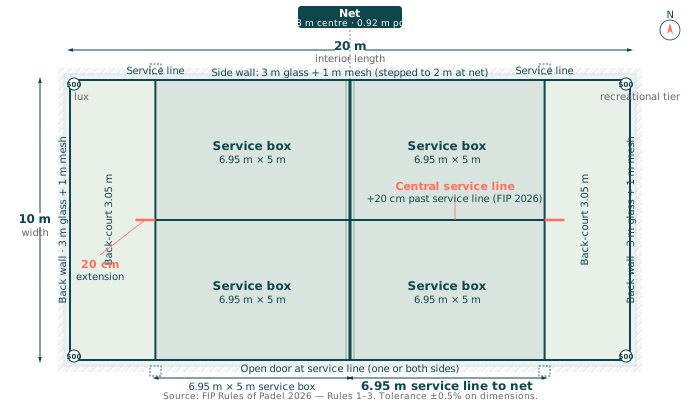
A regulation padel court measures 20 metres long by 10 metres wide. That is 200 square metres of playing surface, divided in half by a net 88cm high at the centre and 92cm at the posts. Service boxes sit 3 metres behind the net on each side.
The cage around the court is what makes padel padel. The back walls are 3 metres of toughened glass, with 1 metre of metal mesh stacked on top to bring the total back height to 4 metres. The side walls combine glass panels and mesh in a stepped pattern.
The walls are not out of bounds. They are part of the rally. A ball that bounces once on your side can ricochet into the back glass, off a side wall, even off your own walls before you hit it back. The court is a playable, three dimensional space, not a flat rectangle.
Most modern courts in the UK and Bali are stepped central courts, but you’ll also see open-sided panoramic courts at premium venues. Panoramic courts have no corner posts, just continuous curved glass, which changes ball behaviour subtly in the corners.
If you want the full numbers (door widths, light heights, ceiling clearances, surface specifications), our padel court dimensions and layout guide breaks down every measurement against the FIP rules of the game.
Padel vs tennis and pickleball
People reach for tennis and pickleball as comparisons, but padel sits in its own lane. A padel court is roughly a third of the playing area of a tennis singles court, yet the cage and the doubles format mean rallies are typically longer than tennis, not shorter. Power matters less, positioning matters more.
Versus pickleball, padel is bigger, faster and uses walls. Pickleball is played on a 6.1 by 13.4 metre court with a perforated plastic ball and no walls, scored to 11 points per game. Padel uses a pressurised felt ball, scores like tennis and rewards the kind of slice and lob you would recognise from a tennis court.
Padel is also doubles only at any serious level, where pickleball is happily played as singles or doubles. And padel’s serve is underarm with a bounce, where pickleball’s is underarm without one.
For a full side by side that covers gear, court costs, learning curve and injury patterns, see our deeper comparison at padel vs tennis, pickleball and squash.
Why padel has exploded
The headline reason is the learning curve. A complete beginner can rally and score a point in their first session. That is rare in racket sports. Tennis often takes weeks to feel rewarding, squash punishes mistakes hard, and badminton needs decent technique to keep the shuttle alive.
Padel rewards good positioning and patience over power. That makes it mixed at club level. Older players, juniors, mixed gender groups and mixed ability friends can share a court without anyone being miserable. Few sports manage that.
It is also social by construction. You need four people. You play side by side with a partner. Most clubs run open sessions, ladders and Americano or Mexicano formats designed to introduce strangers. Two hours on a padel court usually turns into a drink afterwards.
Weather is the other big lever. The UK and northern Europe lean heavily on indoor courts that play through any season, while the UAE and Indonesia use covered outdoor courts to escape sun and rain. Padel works year round in markets where tennis closes for the winter.
Then there is the celebrity factor. David Beckham, Jurgen Klopp, Andy Murray, Zlatan Ibrahimovic and Daddy Yankee have all invested in clubs, sponsored players or built courts of their own. Premier Padel’s QSI backing has put the sport on Sky, Eurosport and beIN, and the visibility feeds straight back into demand for courts.
Padel around the world
Padel’s footprint in 2026 is global. The FIP counts more than 130 member federations, and the map of player density has shifted a long way from its Iberian origins.
Spain. Still the heart of the sport. Around 6 million regular players, roughly 12,000 courts, and the highest concentration of coaches anywhere. Madrid hosts the Premier Padel Major and the bulk of the pro circuit’s commercial heft.
United Kingdom. The LTA took on padel as its governing body in 2019. By 2025 the UK had passed 1,000 courts, and the LTA reports roughly 860,000 active players. London, Manchester, Birmingham and Bristol lead, but rural clubs are catching up fast.
Bali and Indonesia. The 2022 to 2025 boom turned Canggu, Seminyak and Ubud into a south-east-Asian padel hub. Most courts are bookable through Playtomic or Instagram DM, and the scene is social-led rather than league-led. Find courts on our listings directory.
UAE. Dubai and Abu Dhabi both host Premier Padel events, and the courts-per-capita is the highest outside Iberia. The market is luxury-led - rooftop clubs, hotel partnerships and gleaming panoramic courts - and it’s growing fast through 2026.
United States. Late to the party but accelerating. Florida (Miami, Tampa), Texas (Austin, Dallas) and New York lead, with new builds opening monthly. The US Padel Association is working through governance now that the sport has hit critical mass.
Sweden, Italy and France round out Europe’s top tier; Argentina, Mexico and Brazil dominate Latin America; Australia and Singapore are the new frontiers in Asia-Pacific.
Is padel right for you?
Short answer: probably yes. Padel has the lowest entry friction of any major racket sport, and the patterns we see at UK club ladders suggest most newcomers stick with it past three sessions.
Tennis players have the easiest transition. The scoring, the timing, the slice backhand and the lob all carry over. You’ll lose a few rallies to over-hitting in the first hour, then settle.
Squash players read the walls instantly. The cross-court patterns and the boast off the side glass feel familiar. The doubles spacing takes longer to learn than the wall play.
Runners and fitness regulars manage the demand easily. Expect 350 to 500 calories per hour at club intensity, with less impact than tennis and more lateral work than running.
Older players get a sport that scales gently. The short court means less ground to cover, the underarm serve means less shoulder load, and the doubles format means more recovery between shots. We regularly see 60-plus regulars at every club ladder.
Absolute beginners with no racket background still get rallying inside the first hour. Padel is the easiest racket sport to start. Book your first session, follow our first session walk-through, and you’ll be hooked or honestly out of it within 90 minutes.
What you need to start
Padel has one of the lowest entry costs in racket sports. Three pieces of kit, one partner, one court booking and you are in. Most clubs rent rackets for a few pounds per session, so you do not need to buy anything to try your first game.
The racket is solid, stringless and made of foam and carbon or fibreglass composite. Beginner rackets typically have a round head, an even balance and a slightly larger sweet spot. Expect to pay £60-120 in the UK (~$75-150 US, ~€70-140 EU, ~AED 280-550 UAE) for a sensible starter. Our beginner racket guide breaks down the trade offs.
Padel balls look like tennis balls but sit at slightly lower pressure, giving a softer bounce. Buy ITF or FIP approved balls in tubes of three. A tube costs around £6-8 in the UK (~$8-10 US, ~€7-9 EU, ~AED 28-37 UAE) and lasts a casual player a few sessions.
Shoes matter more than people expect. Padel surfaces are typically artificial turf with sand infill, so you want a padel specific or clay court shoe with a herringbone sole, not a flat trainer. Running shoes will slip and risk an ankle.
For a full starter list (clothing, grips, bag, overgrips, water bottle) see our padel kit checklist. When you are ready to book your first game, our walkthrough of your first padel session covers what to expect on court, and the levels guide helps you find players around your standard.
Frequently asked questions
What is padel?
Padel is a doubles racket sport played on a 20 by 10 metre enclosed court with glass and mesh walls that stay in play after the ball bounces. Players use solid, stringless rackets, an underarm serve and tennis-style scoring. It was invented in Mexico in 1968 and is now the world’s fastest growing racket sport.
Is padel the same as paddle tennis?
No. Padel and paddle tennis are different sports despite the similar name. Padel originated in Acapulco, Mexico in 1968 and is played in doubles on a 20 by 10 metre walled court. Paddle tennis is an older American sport played on a smaller, open court with different rules and no back walls. The two are not interchangeable.
How is padel different from paddle tennis?
Padel uses an enclosed 20 by 10 metre court with glass and mesh walls that stay in play, and tennis-style scoring. Paddle tennis (sometimes called pop tennis) is played on a smaller open court with no walls, a different ball pressure and shorter sets. Padel is the global sport with a professional Premier Padel tour; paddle tennis remains largely a regional American game.
Is padel easy to learn?
Yes, padel has one of the lowest entry barriers in racket sports. Most beginners are rallying and scoring points inside their first session, because the court is enclosed, the serve is underarm and rackets are forgiving. Reaching club competitive level takes longer, but the first hour is fun rather than frustrating.
How big is a padel court?
A regulation padel court measures 20 metres long by 10 metres wide, giving a total playing area of 200 square metres. The cage around it stands 4 metres high, made up of 3 metres of glass at the back with a metre of metal mesh on top, and a stepped glass and mesh pattern on the sides.
Why is padel growing so fast?
Padel grew because it is easy to start, social by design (always doubles), playable year round indoors and backed by serious investment. Premier Padel, founded in 2022 with Qatar Sports Investments, has globalised the pro tour, and celebrity backers like David Beckham and Jurgen Klopp have pushed mainstream visibility.
Is padel an Olympic sport?
Not yet. Padel is not currently on the Olympic programme, but the FIP has campaigned for inclusion and the sport is recognised by major regional Games organisers. The IOC reviews new sports on a Games-by-Games basis, and padel’s global growth in 130 plus countries makes a strong case for future inclusion.
What is the best age to start padel?
There is no best age. Padel is played by kids from around six (with junior rackets and softer balls) right through to regular over-70s players at most UK clubs. The underarm serve, short court and doubles format make it gentler than tennis at both ends of the age range, so families and mixed groups share courts easily.
How much does it cost to play padel?
A one-hour court is typically £24-40 in the UK (~$30-50, ~€28-47, ~AED 110-180) split four ways, so £6-10 a head. Bali sits lower at IDR 300-500k a court. Racket hire runs £3-5, a tube of balls £6-8. A sensible starter racket is £60-120 (~$75-150), so full kit comes in under £150.
Where can I play padel?
Padel is played at dedicated clubs and tennis or sports centres that have added courts. The UK, UAE and Indonesia all have rapidly growing scenes, with Spain and Argentina still the largest by player count. The fastest way to find a court near you is to browse the Padeli directory at padeli.com/listings.
Find a padel club near you
The fastest way to know what padel is - is to play it. Padeli lists hundreds of clubs across the UK, UAE, Bali and beyond.
