Padel court dimensions and layout
A padel court is a 20 m by 10 m rectangle, enclosed by 3 m of glass topped with 1 m of metallic mesh and divided by a net set at 0.88 m in the centre and 0.92 m at the posts. The FIP 2026 rulebook allows a 0.5% tolerance on the main dimensions. At 200 m², a padel court is roughly 77% the size of a tennis doubles court (around 260 m²), not a third the size as is often claimed.
A padel court measures 20 m long by 10 m wide, giving 200 m² of playing area. It is enclosed by walls of 3 m glass and 1 m mesh, divided by a net 0.88 m high at the centre and 0.92 m at the posts. The FIP 2026 rulebook permits cement, synthetic or artificial-grass surfaces and applies a 0.5% tolerance to the main dimensions.
The padel court at a glance
A padel court is a 20 m by 10 m enclosed rectangle. That gives you 200 m² of playable area, walled on all four sides by a combination of 3 m of toughened glass and 1 m of metallic mesh sitting above it. A net cuts the court in half across its 10 m width.
You will often read that a padel court is “a third the size of a tennis court”. That is wrong. A tennis doubles court is about 260 m². A padel court at 200 m² is closer to 77% of that footprint. The play is tighter, but the court itself is not tiny.
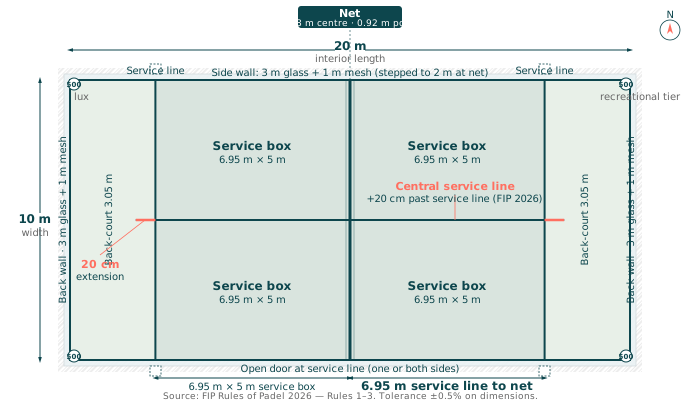
Court dimensions and tolerances
The numbers below come straight from the FIP Rules of Padel 2026. They are the spec every homologated court is built to.
Length runs 20 m, width 10 m, and the FIP permits a tolerance of 0.5% on those figures. That is 10 cm of give on the length and 5 cm on the width before a court falls outside spec.
All court lines must be 5 cm wide and finished in a colour that contrasts with the playing surface. The service line on each half sits 6.95 m back from the net, defining the depth of the service area.
The central service line, which splits each service area into a left and right box, must extend a minimum of 20 cm past the service line on the back-wall side. That extension was always required in practice; FIP 2026 only clarified the wording.
The net
The padel net stretches the full 10 m width of the court. It sits 0.88 m high at the centre and rises to 0.92 m at the posts, with a FIP tolerance of plus or minus 0.005 m on those heights.
If a serve clips the net cord and still lands in the correct service box, it is a let and the serve is replayed. There is no “no lets” rule in padel, despite what you might hear at the club bar.
Padel’s net is lower than tennis. A tennis net is 0.914 m at the centre and 1.07 m at the posts. The drop in height is part of what makes padel rallies flow the way they do.
The walls (glass and mesh)
The walls are what make padel padel. Once the ball has bounced on the floor, you can play it off the walls in the same way snooker plays off cushions. Without that, you are just playing low-net tennis.
End walls are built from 3 m of toughened glass with 1 m of metallic mesh fitted above, giving a total height of 4 m. The same 4 m total applies to the side walls, but FIP 2026 recognises two layouts.
Variant 1 (stepped): 3 m of glass at the back corners that steps down to 2 m of glass nearer the net, with metallic mesh filling the space above. This is the older, cheaper build still seen at many community clubs.
Variant 2 (panoramic): single-piece crystal glass running the full height with no internal posts. The end panels measure 3 m by 4 m. This is the premium look used at every Premier Padel event.
The court entry, often called the “open door”, typically sits level with the service line on each side. That gap counts as out of play; a ball that exits through it is dead.
Service boxes and lines
Each side of the net has a service zone measuring 6.95 m deep from the net to the service line and the full 10 m width of the court. That zone is split into two service boxes by the central service line.
Every service box therefore measures 6.95 m deep by 5 m wide. The server stands behind the service line on their own half and must land the serve into the diagonally opposite box, after a single underarm bounce behind the line.
The central service line extends a minimum of 20 cm past the service line towards the back wall. This makes it easier for receivers and umpires to judge whether a serve landed in the correct box when the bounce is near the line.
A serve that lands in the wrong box, or fails to clear the net, is a fault. Two faults in a row and the receiving pair wins the point.
Playing surfaces (FIP 2026)
FIP 2026 lists three permitted surfaces: cement, synthetic and artificial grass. Older rulebooks also mentioned wood and porous conglomerate. Those have been removed from the current spec.
In practice, artificial grass with a sand infill is the universal competition surface. It governs how high the ball bounces, how much it slides and how the players’ feet move through a slide-step. Walk onto any club court in the UK, UAE or Indonesia and you will be playing on it.
Cement and pure synthetic surfaces still exist but you will mostly find them at older specialist clubs or on outdoor public courts in southern Europe. They play faster and with less slide than sand-filled grass.
Court types - panoramic vs standard, indoor vs outdoor
Two big choices define a padel court beyond its dimensions: the wall design and whether it is covered.
Panoramic court: single-piece glass each side with no corner posts. The view from outside is uninterrupted, which is why every Premier Padel match is played on one. It is also the more expensive build.
Standard court: stepped glass with corner posts, sometimes called a “post court”. Cheaper to build and maintain, still fully FIP-compliant, and the wall behaves identically once the ball is in play.
Indoor: covered, no wind, consistent temperature, slightly slower-feeling ball through the air. Common in northern Europe, the UK and any climate where year-round play matters.
Outdoor: open to the elements. Wind affects high balls more than you might expect, sun glare can ruin a smash, and the surface plays faster in heat. Common in Spain, the UAE, Bali and most warm-climate markets.
Lighting
Court lighting is measured in lux, and the FIP sets minimum levels by tier of play. The table below pulls those minimums together.
| Level of play | Minimum lux |
|---|---|
| Recreational | ~200 lux |
| Amateur competition | 300 to 500 lux |
| Non-broadcast professional | 750 lux |
| TV broadcast | 1,000 lux minimum |
The figures above are widely used across club specifications; the FIP Court Homologation Annex is the binding reference if your venue is applying for an official rating.
Frequently asked questions
What size is a padel court?
A padel court measures 20 m long by 10 m wide, giving 200 m² of playing area. The FIP Rules of Padel 2026 apply a 0.5% tolerance on those main dimensions, so any homologated court will sit within a few centimetres of the spec.
Is a padel court the same size as a tennis court?
No. A padel court at 200 m² is around 77% the size of a tennis doubles court, which sits at roughly 260 m². The “a third the size” line you sometimes hear is wrong. The play feels tighter because of the walls, not because the court itself is small.
How tall are padel court walls?
Padel court walls are 4 m tall in total: 3 m of toughened glass at the bottom and 1 m of metallic mesh fitted above it. Side walls can either step down to 2 m of glass near the net or run as full-height panoramic panels.
What surfaces are allowed under FIP 2026?
The FIP Rules of Padel 2026 permit three surfaces: cement, synthetic and artificial grass. Artificial grass with a sand infill is by far the most common in club and competition play. Wood and porous conglomerate appeared in older rulebooks but are no longer listed.
What is a panoramic padel court?
A panoramic padel court uses single-piece crystal glass along each side wall with no internal corner posts, so the view from outside is uninterrupted. The 3 m by 4 m end panels stay the same. Every Premier Padel match is played on a panoramic court.
How high is a padel net?
A padel net is 0.88 m high at the centre and 0.92 m at the posts, with a FIP tolerance of plus or minus 0.005 m. That is lower than a tennis net, which sits at 0.914 m in the centre and 1.07 m at the posts.
Find a padel court near you
Now you know what a proper padel court looks like, the next step is booking time on one. Padeli lists hundreds of clubs across the UK, UAE, Bali and beyond, with court counts, surface types and panoramic vs standard build flagged where we have it.
