The padel serve
The padel serve is underarm only. You bounce the ball once on the floor behind the service line, then strike it at or below waist level, diagonally into the opposite service box. From 2026 the FIP rule needs one foot behind the line (it was both) and the ball must not cross the service line until you strike it. Lets exist on serve.
A legal padel serve is underarm only. Bounce the ball once on the floor behind the service line, strike it at or below waist level, and land it diagonally in the opposite service box. From 2026 the FIP rule needs one foot behind the line (it was both), and the ball may not cross the service line before contact. Lets exist on serve - a let serve is replayed.
This is the Padeli editorial walkthrough of the padel serve under the FIP 2026 rulebook, adopted at the FIP General Meeting in Acapulco on 28 November 2025. If a rule is contested, the FIP text is the primary source. For every other rule of the game, see our padel rules guide.
How a legal padel serve works
The padel serve is a low underarm strike, never an overhead. It must clear the net and land diagonally in the opposite service box. The geometry is identical for both partners during a game: the same server completes the game from alternating sides, switching court after every point.
- Stand with at least one foot behind the service line and on the correct side of the central line (FIP 2026 Rule 6, new wording for 2026; the previous edition required both feet behind the line).
- Bounce the ball once on the floor behind the service line.
- Strike the ball at or below waist level.
- The ball may not cross the service line or the imaginary line until it is struck (FIP 2026 Rule 6 point 2, new clause for 2026).
- Land the ball diagonally in the opposite service box. After the bounce it may touch the side wall and stay in play; it may not touch the metallic mesh.
Each match opens with a compulsory 3-minute warm-up rally, set out in FIP 2026 Rule 2. The server gets two service attempts per point. A second fault loses the point.
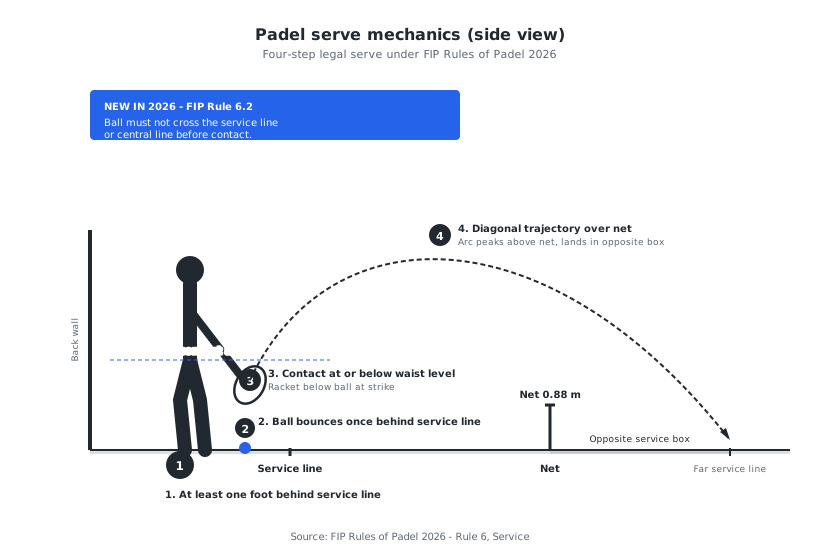
What changed in the 2026 serve rule
Two FIP-level changes to the serve were adopted at the FIP General Meeting in Acapulco on 28 November 2025, then published in the December 2025 rulebook. They both sit inside Rule 6 and they both matter at club level, not just on tour.
The first is the one-foot rule. Pre-2026 you needed both feet behind the service line at the moment of contact. From 2026 you need at least one foot behind the line, with the other free.
The second is the ball-may-not-cross-line clause in Rule 6 point 2. The FIP 2026 text states that the ball may not cross the service line, or the imaginary line that extends it, until it is struck. In practice, you cannot toss or step forward and contact the ball over the line.
| Element | Pre-2026 | FIP 2026 |
|---|---|---|
| Feet at contact | Both feet behind the service line | At least one foot behind the service line |
| Ball position before contact | No specific clause | Ball may not cross the service line until struck (Rule 6 point 2) |
Faults, lets and second serves
A fault is any serve that breaks the Rule 6 conditions. You get two attempts per point - the second serve. If the second is also a fault, the receiving pair wins the point. The umpire or the receiving pair calls faults; at club level players self-call honestly.
Foot fault. Any foot crossing or touching the service line at the moment of contact. Standing on the line counts as a fault; the line is out of play for the server’s feet.
Net fault. The ball lands in the net, lands outside the correct diagonal service box, or hits the receiver’s metallic mesh on the full. A serve that bounces in the correct box and then touches the mesh before its second bounce is also a fault (Rule 7). Bouncing in the box and then hitting the glass is fine.
Bounce fault. Striking the ball before the floor bounce, missing the ball entirely on the strike attempt, or making contact above waist level.
Lets exist in padel. Under FIP 2026 Rule 9, a serve that clips the top of the net and lands in the correct service box is a let, and the serve is replayed. The “padel has no lets” idea you may have read is wrong.
Serve targets and tactics for beginners
The opposite service box gives the server three usable target zones. Pick one and commit to it; a confident half-pace serve into a chosen zone is harder to attack than a flat, fast serve hit nowhere in particular.
Body serve. Aimed at the receiver’s hip on their dominant side. It is the hardest serve to return cleanly because the receiver cannot choose forehand or backhand and has no room to swing freely.
T-line serve. Aimed at the central service line, the “T”, where the central line meets the service line. Opens up a sharp cross-court angle and lets the server’s partner crowd the net to volley the return.
Wide serve. Angled toward the side glass. The receiver has to stretch wide and often returns off the side wall, giving the server’s pair an attacking second ball at the net.
Beginner advice: build consistency on a flat T-line serve first. Variation and spin come after a 50% first-serve-in rate is habitual. Don’t try to ace - placement beats pace at recreational level, and a missed first serve hands the initiative straight back to the receiver.
Mixed-doubles serve order
The serving pair chooses which partner serves first; the receiving pair chooses which partner returns first. Both choices are locked in for the rest of the set. The serve passes to the other pair after each game.
Mixed doubles uses the same serving order. The same-sex receive rule on the decisive point applies under the Star Point and Golden Point formats: the receiver of the same sex as the server takes the decisive ball.
Common serve mistakes
Most beginner serve faults come down to five repeat issues. Fix these and your first-serve-in rate climbs fast.
- Lifting the elbow above the shoulder before contact, which drags the strike point above waist level and turns it into a fault.
- Stepping over the line at contact. The serve is a static motion; you do not run into it.
- Trying to overhead-serve. Overhead serving is a fault in padel. The serve is underarm only, struck at or below waist level.
- Forgetting the bounce. The ball must bounce once on the floor behind the service line before you strike it; striking out of the hand is a fault.
- Standing too far back from the service line. The closer you are to the line at contact, the sharper your serving angles into the opposite box.
Frequently Asked Questions
Can you overarm serve in padel?
No. The padel serve is underarm only, with contact at or below waist level. Overhead serving is a fault under FIP 2026 Rule 6.
What changed in the padel serve rule for 2026?
Two changes were adopted at the FIP General Meeting in Acapulco on 28 November 2025. You now need at least one foot behind the service line at contact (it was both feet), and the ball may not cross the service line until it is struck (FIP 2026 Rule 6 point 2).
Do lets exist on padel serves?
Yes. Under FIP 2026 Rule 9, a serve that clips the net cord and lands in the correct diagonal service box is a let, and the serve is replayed. The “padel has no lets” idea is incorrect.
How high can a padel serve go?
The strike point must be at or below waist level. The trajectory after contact can go as high as you like and still be legal, but contact above waist height is a fault under FIP 2026 Rule 6.
Can I serve from anywhere behind the line?
You can stand anywhere behind the service line on the correct side of the central line, but from 2026 the ball itself may not cross the service line until it is struck (FIP 2026 Rule 6 point 2). Both the bounce and the strike happen behind the line.
Where can the server’s partner stand?
Anywhere on their own side of the net. Rule 3 of the FIP rules fixes only the server and the receiver; both partners can stand wherever they like on their side.
