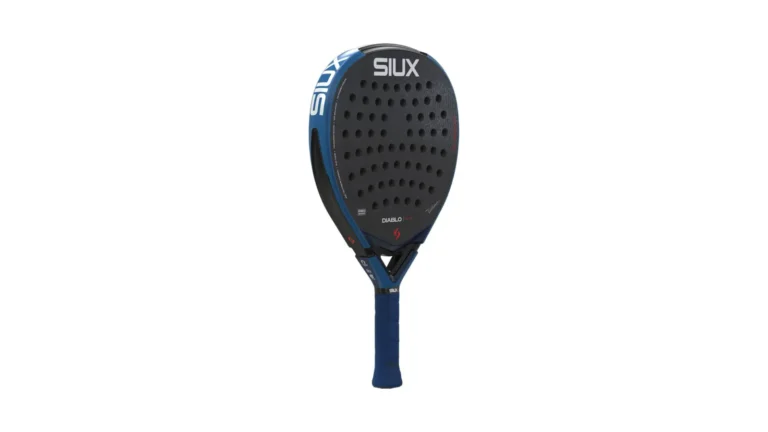
Padel racket 12K vs 18K is about thread size, not stiffness: the K counts the thousands of carbon filaments in each strand of the face weave, so 12K means 12,000 and 18K means 18,000. Lower K gives a finer weave and higher K a wider, heavier tow, but no manufacturer we checked rates 18K as generally stiffer. Layers, core and resin matter more than the K number. Padel Market sells the Nox AT10 Genius Attack in 12K and 18K at the same price, £154.99 on 30 October 2026. Last updated: October 2026.
Links to retailers on this page are affiliate links. If you buy through them, Padeli may earn a small commission at no extra cost to you. It never affects which products we recommend or how.
Padel racket 12K vs 18K vs 3K at a glance
The table sets the three carbon grades side by side with one UK example each. For full reviews of the top models in every grade, see our guide to the best padel rackets.
| Carbon grade | Filaments per tow | Weave | What the brands say | Example racket | UK price, October 2026 | Where to buy |
|---|---|---|---|---|---|---|
| 3K | 3,000 | Finer, tighter, small squares | Nox ML10 (retailer copy): soft and controlled. Babolat: explosiveness and precision | Nox ML10 Ventus Control 3K 2026 | £145.99 | Check price |
| 12K | 12,000 | Wider, heavier tow | Nox: more rigid face. Bullpadel (retailer copy): medium hardness | Nox AT10 Genius Attack 12K Alum Xtrem 2026 | £154.99 | Check price |
| 18K | 18,000 | Wider, heavier tow again | Nox: solid and comfortable feel | Nox AT10 Genius Attack 18K Alum 2026 | £154.99 | Check price |
Nox calls its 12K face the more rigid one and its 18K face the more comfortable one, the reverse of what some shop guides claim. That is the first sign the K number is not a stiffness scale.
What does 3K, 12K, 18K mean on a padel racket?
The K on a padel racket counts the carbon filaments in each tow, the bundle woven into the face: 3K is 3,000 filaments, 12K is 12,000 and 18K is 18,000. It is a textile measure from the fibre industry, not a padel performance score.
Carbon fibre maker Toray lists its common tow sizes as 1,000, 3,000, 6,000, 12,000, 24,000 and 36,000 filaments. Its standard T300 fibre comes in 1K, 3K, 6K and 12K, so the same fibre can be sold in several K grades.
The K grade changes how the weave looks. A lower K gives a finer, tighter weave, and Nox describes its 3K weave as carbon yarns interwoven into small squares. A higher K gives a wider, heavier tow.
Is higher-K carbon better?
A higher K is not better or stiffer by itself. K counts filaments, while stiffness comes from the fibre’s modulus, a separate grading. A 3K and a 12K tow made from the same modulus fibre are equally stiff, filament for filament.
Toray grades its fibres by modulus: standard at about 33 to 34 Msi, intermediate at 42 Msi and high modulus above that, in its MJ and M series. None of the racket pages behind this guide lists the modulus of its face, the figure that would actually describe stiffness.
Higher K is also the cheaper fibre, not the premium one. Relative fibre cost falls as K rises, with 1K the most expensive and 24K the cheapest, so an 18K label is no sign that a brand spent more on the face.
This is why shop guides contradict each other. Some say 18K plays firmer than 12K, one says 3K plays tighter and drier than 18K, and another says 12K is stiffer than 18K. Each credits the K number for a difference that the core, the layers and the resin made.
Is 18K carbon better than 12K?
18K carbon is not better than 12K as a rule; it depends on the racket around it. Nox says its 12K Alum Xtrem face reduces fibre waviness and interlacing by 50% for a finer, smoother, more uniform and more rigid face, while its aluminised 18K gives a solid and comfortable feel.
The Nox AT10 Genius Attack pair is the cleanest 12K vs 18K comparison on sale. Both are high-balance diamonds at 360 to 375 g and 38 mm thick. The 12K uses an HR3 Black EVA core; the 18K uses an MLD Black EVA multilayer core plus 2 g and 4 g Weight Balance pieces.
The carbon is one of three changes between the two AT10 Genius Attack rackets, and on 30 October 2026 both cost £154.99 at Padel Market. Choose on the core and the weight system, not on 12K vs 18K.
Is 3K or 12K carbon softer?
Neither 3K nor 12K is softer by default, because the core decides most of the softness. The Nox ML10 Ventus Control 3K 2026 pairs 3K faces with Nox’s HR3 low-density EVA core and a round shape, and retailer copy calls its feel soft, flexible and very controlled.
The Babolat Technical Viper 3.0 2026 also has a 3K Carbon surface, but with a Hard EVA core, a diamond shape and a head-heavy balance at 370 g +/- 10 g. Babolat says its 3K Carbon gives maximum explosiveness and precision. Same weave, opposite feel: read 3K as a finer weave, not a promise of softness.
Which carbon is best for beginners?
For beginners, the carbon grade matters far less than the shape, weight and core. A round or teardrop racket with a soft core is more forgiving on off-centre hits, whatever the K number. Our guide to choosing a padel racket sets out that order step by step.
The Nox Nextgen Pro Hybrid 3K NFA Series 2025 is the cheapest carbon-faced racket in this guide at £113.99 at Padel Market. It is a medium-balance teardrop with a Carbon 3K face and an HR3 EVA core, aimed at intermediate and advanced players.
Fibreglass is the other route to a softer feel. Retailer copy for the Adidas Metalbone Team 2026 describes its fibreglass faces as a flexible material that gives a softer feel and good ball output.
Before spending on a carbon face, play a few sessions at a padel club near you and ask to try other players’ rackets.
Does carbon weave affect power or control more?
Carbon weave has a smaller effect on power and control than shape, balance and core. Power comes mainly from a diamond shape and a high balance, as on the Nox AT10 Genius Attack 12K and 18K. The Bullpadel Vertex 05 2027 is also a diamond, balanced at about 25.5 cm. Control comes from a round shape and a low density core, as on the Nox ML10 Ventus Control 3K 2026.
The face matters most for consistency and spin. Nox aluminises its 12K and 18K carbon to keep performance more constant through temperature changes, useful on cold outdoor courts. Rough finishes such as Bullpadel’s Top Spin and the Nox Dual Spin surface are there to grip the ball.
Which carbon padel racket to buy
These five rackets cover 3K, 12K and 18K faces, with UK prices checked on 30 October 2026. For a wider shortlist, see our best padel rackets for intermediate players.
Nox AT10 Genius Attack 12K Alum Xtrem 2026, the 12K power pick
The Nox AT10 Genius Attack 12K Alum Xtrem 2026 is the AT10 Attack diamond that Nox calls more rigid. Retailer copy describes a firm, dry feel.

What you get: Diamond, high balance, 360 to 375 g, 38 mm, 12K Alum Xtrem aluminised carbon faces, carbon frame, HR3 Black EVA core.
Price and where to buy: £154.99 at Padel Market, October 2026.
Who it is for: Advanced attacking players who want a firm, direct response on the smash.
- Diamond
- high balance
- 360 to 375 g
Best for: Advanced attacking players who want a firm, direct response on the smash
£154.99 at Padel Market, October 2026
Check price at Padel MarketNox AT10 Genius Attack 18K Alum 2026, the 18K power pick
The Nox AT10 Genius Attack 18K Alum 2026 shares the shape, balance and weight of the 12K version, with aluminised 18K faces that Nox calls solid and comfortable and Weight Balance pieces to adjust the balance.
What you get: Diamond, high balance, 360 to 375 g, 38 mm, 18K aluminised carbon faces, carbon frame, MLD Black EVA multilayer core, 2 g and 4 g Weight Balance pieces.
Price and where to buy: £154.99 at Padel Market, October 2026.
Who it is for: Advanced attackers who want a more solid, comfortable feel and an adjustable balance.
- Diamond
- high balance
- 360 to 375 g
Best for: Advanced attackers who want a more solid, comfortable feel and an adjustable balance
£154.99 at Padel Market, October 2026
Check price at Padel MarketNox AT10 Genius 18K Alum 2026, the 18K all-round pick
The Nox AT10 Genius 18K Alum 2026 is Agustin Tapia’s teardrop racket, with a medium balance that is easier to move at the net than the Attack diamonds and a Medium hardness rating.
What you get: Teardrop, medium balance, 360 to 375 g, 18K aluminised carbon faces, 100% carbon frame, Black EVA MLD multilayer core, Dual Spin surface.
Price and where to buy: £205.99 at Padel Market, October 2026.
Who it is for: Advanced all-court players who want 18K carbon without the high balance of a diamond.
- Teardrop
- medium balance
- 360 to 375 g
Best for: Advanced all-court players who want 18K carbon without the high balance of a diamond
£205.99 at Padel Market, October 2026
Check price at Padel MarketNox ML10 Ventus Control 3K 2026, the 3K control pick
The Nox ML10 Ventus Control 3K 2026 is the clearest example of a soft 3K racket, with a low density core and a round shape that retailer copy calls soft, flexible and very controlled.

What you get: Round, 360 to 375 g, 3K carbon faces, HR3 low-density EVA core.
Price and where to buy: £145.99 at Padel Market, October 2026.
Who it is for: Control players who want a forgiving 3K racket for long rallies from the back of the court.
- Round
- 360 to 375 g
- 3K carbon faces
Best for: Control players who want a forgiving 3K racket for long rallies from the back of the court
£145.99 at Padel Market, October 2026
Check price at Padel MarketBullpadel Vertex 05 2027, the 12K pro pick
The Bullpadel Vertex 05 2027 is Juan Tello’s diamond racket and the most expensive pick here, built with X-Tend Carbon 12K faces that UK retailers list at a medium hardness.

What you get: Diamond, balance about 25.5 cm, 365 to 375 g, 38 mm, X-Tend Carbon 12K faces, MultiEVA core, Top Spin rough finish.
Price and where to buy: £292.52 at Padel Nuestro or £302.99 at Padel Market, October 2026.
Who it is for: Professional-level players who want a 12K power diamond with a medium feel.
- Diamond
- balance about 25.5 cm
- 365 to 375 g
Best for: Professional-level players who want a 12K power diamond with a medium feel
£292.52 at Padel Nuestro, October 2026
Check price at Padel NuestroPadel racket 12K vs 18K FAQ
What does 18K mean on a padel racket?
18K means each carbon tow in the face weave holds 18,000 filaments. On the same scale 3K is 3,000 and 12K is 12,000. The number describes the weave, not the stiffness, which comes from the fibre’s modulus.
Is 18K carbon stiffer than 12K?
18K carbon is not stiffer than 12K as a rule. K counts filaments per tow and is separate from fibre stiffness. Nox even describes its 12K Alum Xtrem face as more rigid and its 18K Alum face as solid and comfortable.
Is 3K carbon softer than 12K?
3K carbon is not softer than 12K by itself. The Nox ML10 Ventus Control 3K 2026 feels soft because of its low density core and round shape, while the Babolat Technical Viper 3.0 2026 pairs 3K Carbon with a Hard EVA core for explosiveness.
Is 24K carbon worth the money?
A 24K label is not a reason to pay more. Relative fibre cost falls as K rises, with 24K the cheapest and 1K the most expensive. Pay for the shape, core and build that suit your game, not for the K number.
Carbon vs fibreglass padel racket: which suits my game?
Fibreglass suits players who want comfort and easy ball output; carbon suits players who want a firmer, more precise response. Retailer copy for the Adidas Metalbone Team 2026 describes fibreglass as a flexible material with a softer feel. Carbon feel varies more with the core than with the K grade.
What does Alum mean on a Nox carbon racket?
Alum on a Nox racket means aluminised carbon. Nox says aluminising its 12K and 18K faces keeps performance more constant through temperature changes. You will see it on the Nox AT10 Genius 18K Alum 2026, £205.99 at Padel Market in October 2026.