The lob is one of the most important and most underused shots in padel. A well-placed lob pushes your opponents off the net, resets the point and creates attacking opportunities for you and your partner. This guide covers when to lob (defending from the back, transitioning to the net), how to execute different lob types (offensive topspin, defensive slice, body lob), common mistakes (lobbing short, lobbing predictably, lobbing from the wrong court position) and drills to improve your lob consistency to 80%+ in matches. Aim for the back third of the court, not the baseline. Last updated: April 2026.
The padel lob is the most important shot in the game. Not the smash. Not the bandeja. Not the back wall trickshot. The lob. If you understand when and how to use it - from both sides of the net - your level will jump noticeably. We’ve structured this lob masterclass around the technique flaws our coaching contributors most often see in club-level players.
That is a strong claim, but it holds up. Padel at every level is decided by net position. The lob is the primary tool for winning or regaining that position. Without a reliable lob, you cannot compete tactically against any player who understands the game.
Why the lob is so powerful

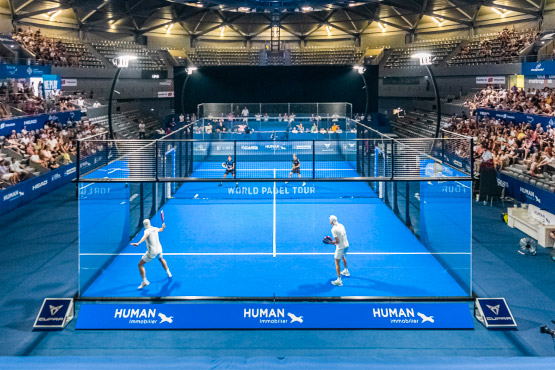
Padel is a game of positions. The team at the net holds the advantage - watch any Premier Padel match and you’ll see the lob being used over and over to break that net dominance.
The lob is what disrupts that advantage - it forces the net pair to retreat, gives the lobbing team time to advance, and often produces a weaker overhead response that leads to a more attackable ball.
A well-executed lob achieves all three of these things simultaneously. A poor lob - short and low - hands your opponents a smash opportunity. The margin between a good lob and a bad one is the difference between winning and losing points at club level.
When to Lob
Lob when your opponents are at or inside the net line, especially if they are leaning forward. A pair that has pushed tight to the net and is pressing its advantage is most vulnerable to a lob over their heads.
Lob to reset when you are under pressure from the baseline. If your opponents are dominating the net and forcing you into defensive positions, a well-timed deep lob breaks their momentum and gives you time to regroup.
Lob when your opponents expect a driving shot. The lob works partly through surprise. If you have been hitting low and hard, switching to a high lob in the same situation creates genuine uncertainty - and uncertainty at the net produces errors.
How to Execute a Good Lob
Contact the ball around waist to chest height on your forehand or backhand side. Use an open face on the racket to generate the upward trajectory. The swing should be compact and controlled - you are not trying to hit the ball hard, you are directing it precisely.
Target the back corners of your opponents’ half. A lob that lands 1 to 2 metres inside the baseline and close to the side wall is significantly harder to put away than one that lands centrally. The corner angle forces the overhead player to step back and across, reducing their smash options.
Height matters more than many players realise. A lob that passes just over your opponent’s extended racket is easy to bandeja. A lob that peaks at 3 to 4 metres above the net forces them to wait under it, which disrupts their footwork and leads to weaker responses.
The Bandeja: The Net Player’s Lob Response
When a lob comes over at you, the bandeja is usually the correct response. The bandeja - Spanish for ‘tray’ - is a controlled overhead played with a flat, slightly downward face. It prioritises placement and retention of the net position over outright power.
Use the bandeja when the lob is deep and you are tracking it back from your net position. Rather than attempting a full smash that risks a mistake, the bandeja redirects the ball into the back corner with backspin, keeps your pair at the net, and pressures your opponents into a difficult defensive position.
The bandeja is executed from slightly behind the ball, with the racket face open and the motion cutting through the ball from high to low. Think of placing the ball rather than hitting it. Control over power is the entire point.
The Vibora: When to Attack with Side Spin

The vibora - Spanish for ‘viper’ - is the attacking alternative to the bandeja. It uses heavy side spin to push the ball wide and low, making it bounce awkwardly into the corner or off the side wall at a difficult angle.
Use the vibora when the lob is short and you are well-positioned close to the net, when the ball sits at shoulder height or above, and when your opponents are already scrambling or out of position. The vibora is your pressure overhead - it is designed to win the point or force a very weak reply.
The execution involves more wrist rotation than the bandeja, with the swing path moving across the ball from right to left (for a right-hander). The side spin produces that characteristic low, skidding bounce that is so difficult to deal with from the corners.
Bandeja vs Vibora: The Decision Framework
The simplest rule: choose the bandeja when the lob is deep and you are being pushed back. Choose the vibora when the lob is short and you are in a position of strength.
A more detailed read: if you are off-balance, scrambling, or the ball is above your head - use the bandeja to keep control of the point. If you are set, the ball is sitting up comfortably, and your opponents are scrambling - use the vibora to win the point outright.
The mistake most players make is using the vibora from bad positions. A vibora hit under pressure rarely lands where you intend it to. When in doubt, bandeja.
Defending Against the Lob
When you are at the net and your opponents lob, your first instinct should be to assess: can I reach it for a bandeja or vibora, or do I need to let it bounce off the back wall?
A lob that is too deep or too high to attack overhead should be allowed to bounce and play off the back glass. Reading the angle of the glass rebound takes practice - the ball typically comes back across the court at a lower angle than you might expect.
Staying patient and letting the glass work for you is more effective than scrambling for an overhead you cannot quite reach.
When you let a lob bounce, your opponents will follow it to the net. Your job from the baseline is to play a controlled defensive shot - either low and at feet level to disrupt their first volley, or a lob of your own to restart the tactical cycle.
Practising the Lob
The lob is one of the most underpractised shots in padel. Most beginners drill volleys and serves, but rarely spend time on the controlled deep lob from mid-court pressure.
A simple drill: one player stays at the net and applies pressure with volleys, the other plays from the baseline and must respond with a lob every third or fourth shot. Focus on depth and height, not pace. Track where the lobs land - most beginners’ lobs are 2 to 3 metres too short.
Fifteen minutes of lob drilling per week will improve your baseline game faster than almost any other practice. The tactical benefits carry over into every session you play.
Lob Practice Drills
Improving your lob requires deliberate practice. Here are two drills that will build your consistency and accuracy.
The target lob drill uses markers placed on the court. Place a towel or cone one metre from the back glass on each side. Hit twenty lobs from the baseline, aiming to land the ball as close to the marker as possible.
A good lob should bounce deep enough to hit the back glass but not so deep that it sits up for an easy smash. Track your accuracy and aim to improve each session.
The pressure lob drill simulates match conditions. Have a partner feed balls at you from the net while you practice lobbing under pressure.
Start with gentle feeds and gradually increase the pace. The goal is to develop the ability to produce a quality lob even when you are stretched or off balance - which is exactly when you will need it most in a real match.