Padel rackets come in three main shapes, and the shape decides where the sweet spot sits and how the weight is spread. A round racket usually has a low balance and a larger, centred sweet spot, so it favours control. A diamond usually has a high balance and a smaller, higher sweet spot, so it favours power. A teardrop sits between the two. Beginners and defensive players tend to suit round or teardrop, all-rounders teardrop, and attacking players who already have good control diamond. For a sore arm, STIGA points to a round shape and LTA Padel to a lighter, softer racket. The examples below start at £91.72 for a round, £100 for a teardrop and £50.01 for a diamond.
By the Padeli editorial team
Prices in pounds, November 2026
Links to Padel Nuestro on this page are affiliate links. If you buy through them, Padeli may earn a small commission at no extra cost to you. It never affects which rackets we mention.
Weight, core, face and budget are in our guide to choosing a padel racket, and our soft vs hard racket guide covers how stiff or soft a racket feels. To get three rackets matched to how you play, try the free Racket Genie.
What do the three padel racket shapes change?
Shape changes the size and position of the sweet spot, and how the weight is spread along the racket.
Wilson’s racket guide puts it the same way: the main difference between round, diamond and teardrop ‘relates to the size and location of the sweet spot and its weight distribution’. Babolat’s guide to its adult padel racquets draws the same three-way split.
| Shape | Sweet spot | Usual balance | Favours | Tends to suit |
|---|---|---|---|---|
| Round | Larger and centred | Low, with the weight towards the handle | Control and easy handling | Beginners and defensive players |
| Teardrop | Between the other two | Medium | A mix of control and power | All-rounders who both attack and defend |
| Diamond | Smaller and higher on the face | High, with the weight towards the top | Power | Attacking players who already have control |
Our glossary has a short definition of head shape if the term is new to you.
How does balance differ between round, teardrop and diamond rackets?
Balance is usually low on a round racket, medium on a teardrop and high on a diamond.
Balance is where the weight sits along the racket. Babolat says a round racket has its weight towards the handle, and STIGA adds that this makes it easier to manoeuvre, at the cost of some power. Wilson gives the teardrop a medium balance point. On a diamond, Babolat says the weight is concentrated at the top, which allows more powerful strokes.
Babolat’s diamond page adds that this type of racket ‘tends to be quite heavy due to its balance and thus more tiring if your game lasts a long time’.
These are patterns, and plenty of rackets break them. Babolat’s own range lists the round Counter Viper 2.6 as head heavy and the diamond Technical Origin + with an even balance, so the balance figure on a racket tells you more than its shape alone.
Where is the sweet spot on each padel racket shape?
The sweet spot is larger and central on a round racket, smaller and high up on a diamond, and in between on a teardrop.
LTA Padel calls the sweet spot ‘the most effective surface on the racket face for hitting the ball’. A large one increases control and consistency, it says, while a small one increases power but brings reduced control when you miss it.
That decides how much an off-centre hit costs you. Babolat says the round shape has a larger, centred hitting zone, which makes shots more forgiving. STIGA puts the diamond’s sweet spot high in the widest part of the racket, so it is harder to hit with precision, but the stroke is more powerful when struck cleanly. Babolat makes the teardrop’s larger than a diamond’s and smaller than a round’s.
Which padel racket shape suits your level?
Round or teardrop suits most new players, while teardrop or diamond suits most advanced ones.
- New to padel: LTA Padel and Babolat both point to round or teardrop, for control. Babolat calls the diamond’s lower control and precision a limiting factor for beginners. Our beginner rackets list starts here, and our first racket page goes through the basics.
- Improving: Babolat says its teardrops suit both beginner and experienced players. Its diamonds are intended for intermediate to expert players, because their power takes more skill to control. Our intermediate list has picks for this stage.
- Advanced: Babolat suggests teardrop or diamond to combine power and control. Round is still an option, as Babolat says its round models suit advanced players as well as beginners. Our advanced rackets list goes further.
- Competing regularly: Babolat says competitive players usually opt for a diamond shape, which it calls ideal for players who already have a lot of control and want more power.
Coming over from tennis? Our list of padel rackets for tennis players picks up from there.
Which padel racket shape suits your playing style?
Round suits long defensive rallies, teardrop suits players who switch between attack and defence, and diamond suits players who like to attack.
That split is how LTA Padel describes them, and each shape gives something up.
- You defend and keep the ball in play: a round racket adds control and consistency. Babolat says the trade-off is less power on strong shots. Our control rackets are mostly built for this game.
- You do a bit of everything: a teardrop gives you room for both. STIGA notes it is not superior in either speed or control if you want a racket that excels at one, and Babolat says players after high precision do better with a round shape.
- You attack and want to finish points: a diamond adds speed and power, and Babolat says its strong point is smashes and offensive shots. The cost is less control and precision. Our power rackets list has picks for this style.
Which padel racket shape is gentlest on a sore arm?
Round is the shape STIGA points to for players recovering from an arm injury, as part of a lighter, more flexible set-up.
STIGA says players recovering from injuries such as tennis elbow should choose a lightweight, balanced racket, and that rackets with a larger sweet spot, like the round shape, and flexible materials are gentler on them. LTA Padel’s tip is similar: with any form of arm pain, ‘a lighter, softer racket could be more suitable’. Babolat’s note that diamonds can be more tiring points the same way.
Shape is only part of it, so a round racket with a stiff carbon face may suit you less than the shape suggests. Our guide to carbon 3K, 12K and 18K explains how face material changes the feel, and our rackets for tennis elbow list goes through models.
This is kit guidance from racket makers and LTA Padel, not medical advice. The NHS says to see a GP if you still have elbow pain after resting it and trying self-care for at least 2 weeks.
Which current rackets are round, teardrop and diamond?
The nine rackets below cover all three shapes, and each shape runs from entry-level models to ones aimed at advanced players.
| Racket | Shape | Balance | Face | UK price |
|---|---|---|---|---|
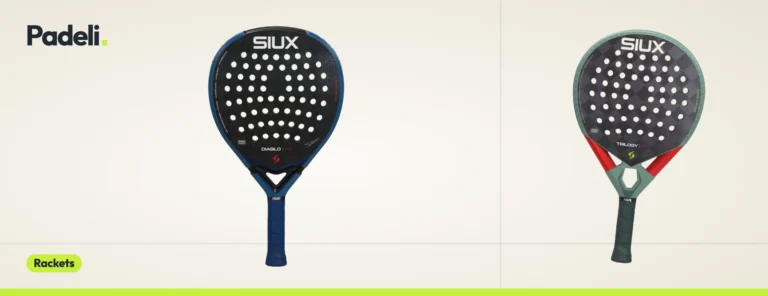
| Siux Trilogy Elite 6 | Round | Low | 3K carbon | £91.72 Padel Nuestro |
| Babolat Counter Vertuo 2.6 | Round | Even | Fibreglass | £160 Babolat |
| Babolat Air Origin | Teardrop | Even | Fibreglass | £100 Babolat |
| Wilson Blade V4 Padel | Teardrop | Medium | Carbon | £133.42 Padel Nuestro |
| Babolat Air Viper 2.6 | Teardrop | Even | 16K carbon | £280 Babolat |
| Bullpadel Indiga Power 26 | Diamond | High | Polyglass | £50.01 Padel Nuestro |
| Babolat Technical Origin + | Diamond | Even | Fibreglass | £130 Babolat |
| Bullpadel Vertex 05 | Diamond | High | 12K carbon | £155.95 Padel Nuestro |
| Babolat Viper Juan Lebrón 3.1 | Diamond | Head heavy | 3K carbon | £340 Babolat |
Round rackets
Babolat puts its Counter Vertuo 2.6 in the easy-power, beginner end of its round range, at 350 g. Round goes up to the top level too. The Siux Trilogy Elite 6 has 3K carbon faces, and Padel Nuestro lists it for advanced and competition players.
Teardrop rackets
Babolat’s Air Origin is the cheapest teardrop here, with fibreglass faces at 345 g. The Wilson Blade V4 Padel has carbon faces, and Padel Nuestro lists it for both beginner to intermediate and advanced players. Babolat’s Air Viper 2.6 moves up to 16K carbon faces at 355 g.
Diamond rackets
The Bullpadel Indiga Power 26 is a cheaper way to try a diamond, with a soft EVA core and Polyglass faces, and Padel Nuestro lists it for beginners and intermediates. Babolat’s Technical Origin + keeps fibreglass faces at 355 g. The Bullpadel Vertex 05 has 12K carbon faces and is listed for advanced and competition players, and Babolat’s Viper Juan Lebrón 3.1 has 3K carbon faces, a hard EVA core and a weight of 370 g.
Are there other padel racket shapes?
Yes, hybrid is the usual fourth label, and some makers have shapes of their own.
Padel Nuestro sorts rackets by round, teardrop, diamond and hybrid. The labels overlap, as Babolat describes its teardrops as having a ‘hybrid shape’. STIGA has a hexagonal shape of its own, called Cybershape. Of the 311 current rackets in our Racket Genie, 134 are diamond, 90 round, 59 teardrop and 28 hybrid.
After the shape: weight, core and face
Weight, core and face come next, and our padel racket buying guide covers each of them. The Genie will turn your answers into three rackets.