The best padel tips put control before power. Get to the net with your partner and hold it, lob to push your opponents back, and let fast balls come off the back glass, using the service line as your decision line. Hit steady balls down the middle, where both opponents may go for the same ball. Most rallies are won and lost by mistakes, not flashy winners, so cut your own errors before you chase winners. Last updated: November 2026.
Padel tips at a glance
These 50 padel tips run in order, from your first match to club level, and each row below names the one tip in each stage that matters most. If you have never played, start with our beginner’s guide to padel in the UK, then come back for the tips.
| Stage | Tips | The one tip that matters most | Why (sourced) |
|---|---|---|---|
| Your first match | 1 to 6 | Wrap the wrist cord before every point | The FIP rules make the wrist cord obligatory |
| Shots and technique | 7 to 12 | Take the racket back early and keep the swing short | LTA: early preparation, short backswing, contact in front |
| Positioning and the net | 13 to 18 | Hit, then recover to your position | Christian Medina Murphy: learn where you have to be, hit the ball and recover |
| Walls and glass | 19 to 24 | Use the service line as your decision line | LTA: bounce before it, play before the glass; after it, let it come off the glass |
| Serve and return | 25 to 30 | Place the serve, then take the net | LTA: placement over power; the serve helps you reach the net |
| Tactics and partner play | 31 to 36 | Win by making fewer mistakes | LTA: most rallies are won and lost by mistakes, not winners |
| Mindset | 37 to 39 | Slow the match down when it goes wrong | Medina Murphy: take more time between points and play controlled points |
| Fitness and injury prevention | 40 to 42 | Look after your elbow, knees and shoulders | The elbow is the most common injury site; tennis elbow is the most frequent diagnosis |
| Kit | 43 and 44 | Start with a round, lighter racket | A round racket has a low balance and the biggest sweet spot |
| Rules and etiquette | 45 to 47 | Know the quick ways to lose a point | FIP: a ball that hits you, or a touch of the net, loses the point |
| Reaching club level | 48 to 50 | Book a qualified coach and join a ladder | The LTA runs a national coach finder |
Is padel easy to pick up? What beginners should know first
Yes, padel is quick to start: the serve is underarm, the court is small and many people rally in their first session. The part that takes longest to learn is the walls, because the ball keeps coming back off the glass and you have to decide when to hit it.
Padel in Britain now has 1.5 million people playing on 2,445 courts at 682 venues, according to LTA figures released on 20 October 2026. About two-thirds of those players also play tennis, so many arrive with a swing that needs shortening rather than building.
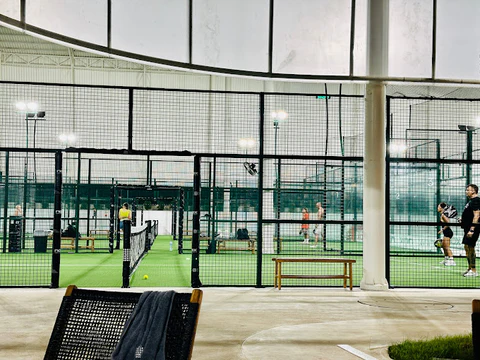
A padel court is 20 x 10 m inside the walls, with a back wall 4 m high in total: 3 m of glass topped by 1 m of metal fence. You only need a racket, padel balls and court shoes, and most venues hire rackets and provide balls.
The best way to use these 50 tips is to read the stage you are at and work on one skill per session. Trying to fix your serve, your bandeja and your positioning in the same hour usually fixes none of them.
Your first match: tips 1 to 6

1. Wrap the wrist cord before every point
The wrist cord is obligatory under the FIP rules, and it is there for a reason: a racket that slips out of a hand in an enclosed court can hit your partner or the glass. Loop it round your wrist before the first point and keep it on for the whole match.
2. Hire a racket and use the venue’s balls at first
The LTA says any standard racket is fine to start with, and most venues hire rackets and provide balls. Play a few sessions on hire kit before you buy, so you know how often you will play and what feels right in your hand.
3. Warm up before the three-minute knock-up
The FIP rules allow a warm-up of 3 minutes on court, which is not long enough to get your body ready. The LTA advice is to raise your heart rate first, then do padel-specific movement for your arms, shoulders, thighs and calves before you step on court.
4. Clear the net with margin
The padel net is 0.88 m high in the centre and 0.92 m at the posts, so the middle is the lowest place to hit over. Beginners lose many points in the net itself: aim a little higher than feels natural and let the walls keep the ball in play.
5. Learn the court lines before the shots
The service line sits 6.95 m from the net on each side of the 20 x 10 m court, and it matters for far more than the serve. It marks the box you serve into and, as tip 19 explains, the line that tells you whether to play the ball early or let it come off the glass.
6. Agree the scoring before you start
The FIP rules allow three ways to score deuce: Advantage, Star Point and Golden Point. With Golden Point, deuce is settled by one deciding point and the receiving pair chooses which side receives it. Agree the format with your opponents before the first serve, because venues and leagues vary.
Shots and technique: tips 7 to 12

7. Take the racket back early and keep the swing short
Early preparation is the LTA’s first rule for padel groundstrokes: take the racket back early, keep the backswing short and make contact in front of you. A short swing gives you time on a small court where the ball comes back fast off the walls.
8. Hit flat until your timing is solid, then add spin
Christian Medina Murphy, the British men’s No.1 with four FIP world circuit titles as of 13 March 2026, advises players to learn timing by hitting flat before adding spin. His advice appeared in an LTA article published on 13 March 2026. Spin is useful later, but it hides timing problems rather than fixing them.
9. Hold the volley ready position
The LTA’s volley ready position has the racket up at contact height, above the net, so the path to the ball is short. Step in with the opposite foot and meet the ball in front of you. A racket that drops to your knees between shots is usually late.
10. Learn the three volleys: block, push and fizz
The LTA teaches three padel volleys: the block, the push and the fizz. The block absorbs a hard ball, the push sends a steady ball deep and the fizz is the attacking volley, played with spin off a slower ball. Learn them in that order, because the block handles fast balls and the fizz only works off a slower ball you can attack.
11. Aim the lob just past the service line
A good padel lob bounces just beyond the opponents’ service line and before their back glass, according to the LTA. Playing it cross-court gives you more margin, because the diagonal is the longest line on the court. A lob that lands short gets smashed; one that hits the back glass on the full is out.
12. Play the bandeja, not the smash
The bandeja is padel’s control overhead, and the LTA says it makes up 69% of overheads in the women’s game. Hit it at about eye height, high to low across your body with underspin, then recover to the net. It keeps you in the attacking position, which a missed smash gives away.
Positioning and the net: tips 13 to 18

13. Treat the net as the place to win points
The pair at the net usually controls a padel point, which is why the LTA calls the serve a tactical shot to help you get there. From the net you can volley at angles and feet; from the back you are mostly defending. Since most rallies are lost on mistakes, the net is where you force them.
14. Hit, then recover to your position
“Learn where you have to be, hit the ball and recover to the position” is Christian Medina Murphy’s positioning advice. The habit to build is the recovery: after every shot, move back to your spot before you watch where the ball went. Stand close enough to volley but not so close that a lob beats you.
15. Move as a pair, like two ends of a rope
Moving together with your partner is one of the LTA’s footwork basics: when one of you goes forward, back or across, the other follows. A gap between you opens the middle of the court. Picture a rope between you that never goes slack.
16. Stay on your toes with short side steps
Short side steps on your toes are the LTA’s footwork advice for padel, because the court is small and changes of direction are constant. Big strides leave you flat-footed when the ball comes back off the glass. Keep the steps small and keep moving between shots.
17. Follow a good lob straight to the net
After an attacking lob, coaches say, you and your partner should take the net straight away. A lob that pushes your opponents back is only useful if you claim the space they leave. Watch the ball go over, then move forward together.
18. Never touch the net
Touching the net or the posts with your body, racket or clothing while the ball is in play loses the point under the FIP rules. It often happens on a close volley or a follow-through after a smash. Stand close enough to attack, but leave room to finish your swing.
Walls and glass: tips 19 to 24

19. Use the service line as your decision line
The LTA uses the service line as a decision line for balls coming towards the back of the court. If the ball bounces before the service line, play it before it reaches the glass. If it bounces after the service line, let it come off the glass and play it on the way out.
20. Turn side-on and wait for the ball off the back glass
To play off the back glass, the LTA says, face the side wall with your racket up and your shoulder pointing at the ball. Then wait until the ball is in front of your leading foot before you hit. Many beginners swing too early, while the ball is still beside or behind them.
21. Let fast balls hit the glass to buy time
A fast ball that bounces beyond the service line will slow down off the back glass, so letting it hit the wall gives you more time, not less. Combine this with early preparation: turn and take the racket back as soon as you decide to let the ball go, then make a short swing.
22. Use your own glass, never your own fence
The FIP rules let you play the ball against your own glass so it then travels into your opponents’ court, the shot coaches call contra pared. Hitting your own metal fence loses the point. Use the glass as an escape when you are stuck deep, not as a regular shot.
23. Know where the glass ends and the fence begins
The back wall of a padel court is 4 m high: 3 m of glass topped by 1 m of metal fence. A ball off the glass comes back predictably; a ball off the fence can drop dead or shoot off at an angle. Read where the ball will strike before you commit to waiting for it.
24. Drill the back-glass feed
The back-glass feed is one of the LTA’s recommended padel drills: a partner or coach feeds balls into the back glass and you practise turning, waiting and hitting. Repetition is how you learn the glass, and a match gives you too few of these balls to improve.
Serve and return: tips 25 to 30
25. Serve legally: bounce, underarm, waist height
The padel serve is underarm under the FIP rules: bounce the ball once in your own box, hit it at or below waist height with at least one foot on the ground, and send it diagonally into the receiver’s box. You get two attempts, as in tennis.
26. Place the serve, then take the net
The LTA calls the serve a tactical shot whose job is to help you reach the net, and it values placement over power. A steady serve to a planned spot, followed by a quick move forward, puts your pair in the attacking position from the first ball of the point.
27. Serve into the side glass
A serve that bounces in the box and then runs into the side glass is effective at all levels of the game, according to the LTA. The ball changes direction off the wall and the receiver has to adjust late. Mix it with serves down the middle so the receiver cannot settle.
28. Keep the serve off the fence
A serve that bounces in the box and then touches the metal fence before its second bounce is a fault under the FIP rules, while glass is allowed. A serve that clips the net and lands in the box is replayed, unless it then hits the fence before the second bounce. Aim for the glass, not the wire.
29. Let the serve bounce before you return it
The receiver must let the serve bounce in padel; you cannot volley it. If the serve hits the receiving player before it bounces, the point goes to the server. Stand where you can take the ball after the bounce and, if needed, after the glass.
30. Pick the return from the serve you get
Coaches match the return to the serve. Against a serve into the glass, block it back towards the server. Against a serve down the T, lob. Against an easy central serve, attack the server’s feet or lob to take the net yourself. Deciding before the serve lands keeps the swing short.
Tactics and partner play: tips 31 to 36

Padel is a doubles game, so most tactics are about the pair, not the player. Our padel doubles strategy guide goes deeper on formations; these six tips are the ones to use from your next match.
31. Play down the middle
Hitting down the middle is often the most rewarding option in padel, the LTA says, because it can make both opponents go for the same ball. It also lowers the net clearance you need and keeps the ball away from the side walls, where angled shots go out.
32. Win by making fewer mistakes
Most padel rallies are won and lost by mistakes, not by flashy winners, according to the LTA. The practical version: play one more safe ball than your opponents. Count your own unforced errors in your next match and you will see where the points really went.
33. Call ‘mine’ or ‘yours’ on every shared ball
The LTA’s communication advice for padel pairs is simple: call “yours” or “mine” on every ball that could go to either player. A clear call stops the clash of rackets and the ball that both players leave. Call early and loud, before the ball crosses the net.
34. Back your partner, they are half the result
“Your partner is 50% of the result,” says Christian Medina Murphy, and the LTA adds that you should build your partner’s confidence rather than criticise errors. A partner who feels blamed plays tight. After a mistake, a quick word about the next point does more than a look.
35. Do not pick a side too early
Coaches advise against picking a side too early. The right side is usually the consistent builder of the point, while the left side is usually the aggressive finisher who covers lobs through the middle. Left-handers usually play on the right. Try both before you settle.
36. Know why you are lobbing before you lob
A lob has one job in padel: to move your opponents off the net so your pair can take it. Aim it just past the service line, cross-court when you need margin, and if it works, take the net with your partner straight away. A lob with no follow-up just resets the point.
Mindset: tips 37 to 39
Close padel matches are often decided by the pair that stays calm, and our padel mental game tips cover routines in more detail. These three are the place to start.
37. Choose consistency over the highlight shot
“Consistency wins padel matches” is how Christian Medina Murphy puts it. The highlight shot looks good once; the steady ball through the middle wins the set. When you are unsure which shot to play, pick the one you make most reliably.
38. Slow the match down when it goes wrong
When he is struggling, Medina Murphy takes more time between points and plays controlled points. The FIP rules allow up to 20 seconds between points, so use that time to breathe, talk to your partner and agree the next serve rather than rushing into another error.
39. Practise under pressure with scoring games
The LTA’s padel drills include scoring games such as ladder rallies, where you build rallies of 2, 3 and then 4 shots and reset on an error, and yellow card / red card. Adding a score to a training session makes every ball matter, which is the closest training gets to a tight match.
Fitness and injury prevention: tips 40 to 42
These tips are general guidance, not medical advice. If you have pain that does not settle, see a GP or physiotherapist.
40. Prepare like a pro: eat early, warm up for 15 to 20 minutes
Christian Medina Murphy eats about two hours before a match and warms up on court for 15 to 20 minutes. You do not need a pro routine, but eating early and arriving in time for a proper warm-up means your first games are not spent getting loose.
41. Look after your elbow, knees and shoulders
The elbow is the most commonly injured part of the body in padel, followed by the knee, shoulder and lower back, and tennis elbow is the most frequent diagnosis, according to a 2023 review by Dahmen et al. in BMJ Open Sport and Exercise Medicine. Warming up, a racket that is not too heavy and a short swing all reduce the load on the arm.
The same review puts padel injury rates at about 3 injuries per 1,000 hours played, or 8 per 1,000 matches. The authors base this on limited research, so treat the figures as a guide rather than a precise risk.
42. Build fitness off court too
The NHS recommends adults do at least 150 minutes of moderate or 75 minutes of vigorous activity a week, plus strength work on 2 days, in its physical activity guidelines. Padel counts towards the total, and strength work for the legs, shoulders and core helps you last longer on court.
Kit: tips 43 and 44
43. Start with a round, lighter racket
UK retailers say a round padel racket suits beginners because it has a low balance and the biggest sweet spot. A teardrop is the all-rounder, and a diamond is head-heavy with a smaller sweet spot, built for advanced players. UK retailers suggest a beginner racket of about 355 to 368 g.
Every legal padel racket is at most 45.5 cm long, 26 cm wide and 38 mm thick under the FIP rules, so the differences between rackets come from shape, weight and balance rather than size.
44. Wear padel shoes with a herringbone sole
A herringbone sole is the usual choice for padel on sand-filled artificial grass, UK retailers advise, because it grips without catching. Running shoes slide on the sand, and that slide is how ankles get turned. Court shoes are one of the three essentials the LTA lists, with a racket and balls.
Rules and etiquette: tips 45 to 47
45. Know the quick ways to lose a point
Three padel rules catch beginners out, all from the FIP Rules of Padel. If the ball hits you anywhere but your racket, you lose the point. Touching the net or posts while the ball is in play loses the point. Hitting your own metal fence loses the point, though your own glass is allowed.
46. Respect the time between points and at change of ends
The FIP rules allow 20 seconds between points and 90 seconds at a change of ends. Pairs change ends after the first game, the third game and every odd game after that, and every 6 points in a tie-break. Keeping to these times is good etiquette in a friendly match too.
47. Understand Star Point, new on the pro tour in 2026
Star Point is a scoring format in the FIP rules that apply from 1 January 2026: a game plays two deuce and advantage cycles, and at the third deuce one deciding Star Point is played, with the receivers choosing the side. Premier Padel has used it from Riyadh Season P1, from 9 February 2026, across a calendar of 26 tournaments in 18 countries.
Some formats also replace a deciding set with a super tie-break to 10 points. UK venues and leagues can use Golden Point, Star Point or Advantage, so check the format when you enter a tournament or league.
Reaching club level: tips 48 to 50

Once you can rally, serve and play off the back glass, the next steps are new shots and structured training. Our guide on how to improve at padel as an intermediate picks up where these tips stop.
48. Learn the vibora, chiquita and bajada
Club players use a wider set of shots with Spanish names. The vibora is an attacking overhead with spin, the chiquita is a soft ball to the net players’ feet and the bajada is an attack off the glass. Advanced players also hit x3 and x4 smashes, which bounce out over the side or back wall.
49. Practise at home between sessions
The LTA suggests two padel drills you can do at home: tap-ups that alternate racket faces, and volleys against an outside wall. Both build feel and a quick racket without a court booking. With a partner on court, add the ladder rally and back-glass feed from our padel drills guide.
50. Book a qualified coach and join a ladder
A qualified coach spots in one session the habit you would take months to notice, and the LTA’s find a coach tool lists coaches near you. Pair lessons with a club ladder or league so you play matches against new opponents, and use scoring drills such as yellow card / red card to keep training honest.
Padel tips FAQ
What are the best padel tips for beginners?
The best padel tips for beginners are to wrap the wrist cord, keep the swing short, clear the net with margin and let balls that bounce past the service line come off the back glass. Get to the net with your partner whenever you can. Most rallies are won and lost by mistakes, not flashy winners, according to the LTA, so keeping the ball in play matters most.
How can I improve quickly at padel?
You improve quickest at padel by cutting mistakes rather than adding winners, because the LTA says most rallies are lost on errors. Work on one skill per session, use the service line as your decision line for the back glass, and practise with scoring drills such as ladder rallies, the back-glass feed and yellow card / red card. A qualified coach speeds this up.
Is padel easy for beginners?
Padel is easy for beginners to start: the serve is underarm, the court is small and most venues hire rackets and provide balls, so you only need court shoes. Britain has 1.5 million padel players, according to the LTA. The hardest part to learn is playing off the walls, which takes repetition to time well.
What one tip takes your padel to the next level?
Consistency is the tip that takes most players to the next level. British No.1 Christian Medina Murphy says that consistency wins padel matches, and the LTA says most rallies are won and lost by mistakes. Play steady balls through the middle, lob to take the net, and save the attacking shot for a ball you can put away.
How often should I play padel to improve?
No governing body sets a number of padel sessions for improving, so focus on how you practise: one skill per session, with drills such as ladder rallies or the back-glass feed. For general fitness, the NHS recommends at least 150 minutes of moderate or 75 minutes of vigorous activity a week, plus strength work on 2 days, and padel counts towards that.
What is the most important shot in padel?
The bandeja is one of the most important shots in padel, the LTA says, because it lets you answer a lob and keep the net. The LTA says the bandeja makes up 69% of overheads in the women’s game. The serve matters too: the LTA calls it a tactical shot, with placement over power, to help you reach the net.
Should I play on the left or the right side in padel?
Coaches advise you not to pick a padel side too early. The right side is usually the consistent player who builds the point, and the left side is usually the aggressive finisher who covers lobs through the middle. Left-handers usually play on the right. Try both sides with different partners before you settle on one.